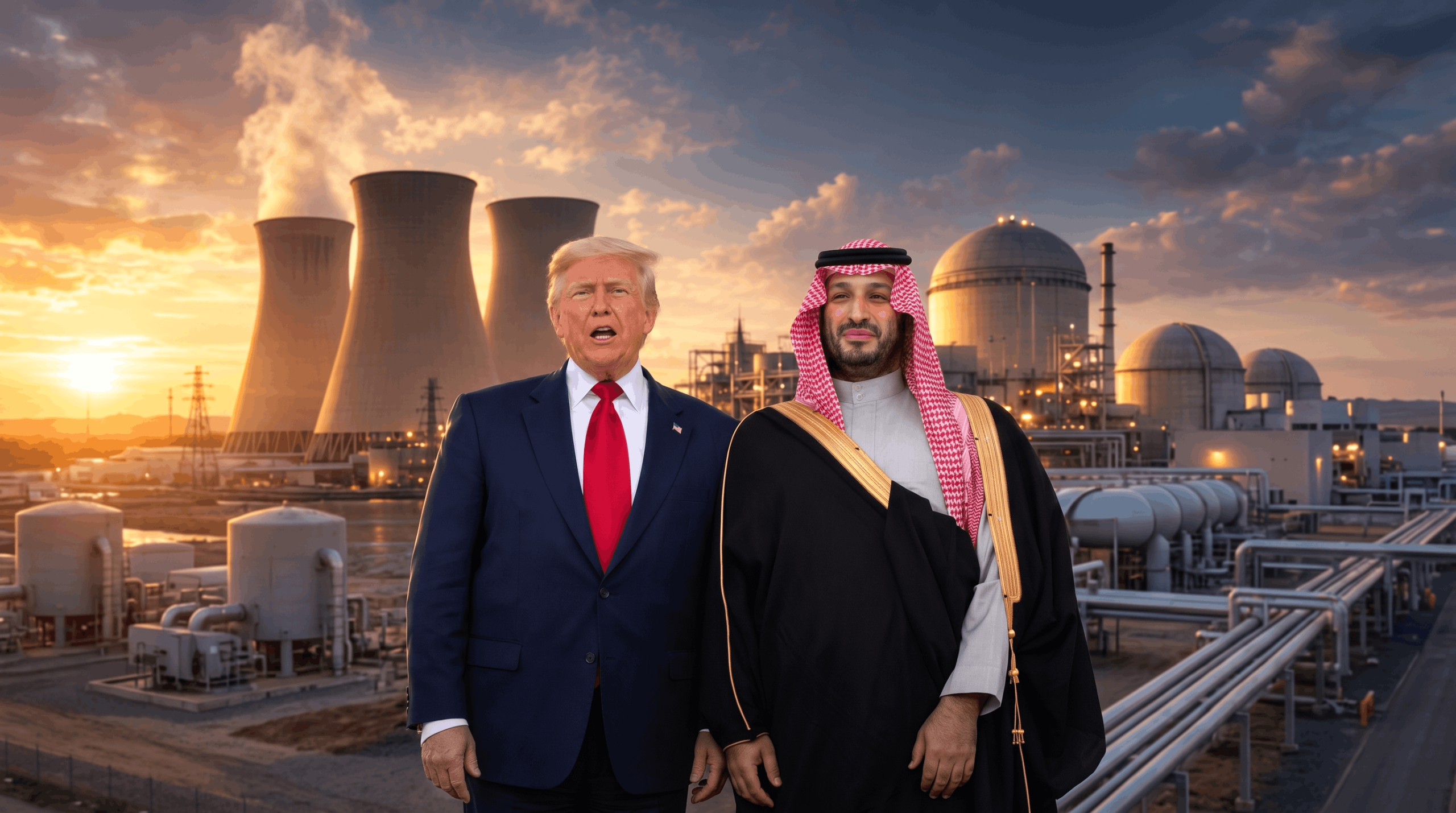
US Energy Secretary Chris Wright and Saudi Energy Minister Prince Abdulaziz bin Salman signed a civil nuclear cooperation agreement on July 22, 2026 and the world is still unpacking what that means. You’ve seen the headlines. But what was actually signed? And should you be worried? For Pakistani and South Asian readers, this is not a distant geopolitical story. Saudi Arabia is one of Pakistan’s most important economic and defense partners, and a Saudi nuclear program even a civilian one reshapes the regional balance of power in ways Islamabad cannot afford to ignore. This post explains what a “123 Agreement” is, what the US Saudi nuclear deal allows, what it doesn’t, and what happens next all in one place.
Key Takeaways
- The US and Saudi Arabia signed a civil nuclear cooperation 123 Agreement on July 22, 2026, covering approximately 30 years and granting US companies priority access to Saudi nuclear infrastructure.
- Saudi Arabia cannot immediately enrich uranium a joint two-year feasibility study must be completed first, and a 10-year restriction applies if the US declines to assist.
- The deal does not include the UAE-style “gold standard” no-enrichment pledge, which nonproliferation experts cite as a significant departure from established norms.
- Congress has 90 days to review and potentially block the deal, though the bar for doing so is extremely high.
- For Pakistan, the deal introduces new variables in Pakistan-Saudi strategic and economic ties that will affect regional security calculations for years to come.
What Exactly Was Signed? A Plain-Language Explainer of the Nuclear Accord Details
A “123 Agreement” takes its name from Section 123 of the US Atomic Energy Act. Think of it like a software licensing agreement: it specifies what you can build, who supervises the process, and what rules you must follow. Without it, the US cannot legally share civilian nuclear technology with another country. It is the legal gateway full stop.
On July 22, 2026, the US and Saudi Arabia signed this agreement alongside a companion bilateral safeguards agreement, which sets out inspection and verification procedures. The key nuclear accord details are as follows:
- Duration: Approximately 30 years
- Commercial access: US vendors most prominently Westinghouse gain priority access to design, build, and supply Saudi Arabia’s nuclear infrastructure
- Oversight: Saudi Arabia must adhere to IAEA (International Atomic Energy Agency) safeguards, including the Additional Protocol, which allows for more intrusive inspections
- Enrichment: Not automatically permitted, subject to a separate feasibility study and specific conditions (more on this below)
The agreement does not hand Saudi Arabia the keys to a nuclear program. It opens the door to civilian nuclear technology under a defined legal and supervisory framework. What Saudi Arabia does next, within and beyond that framework, is where things get complicated.
Timeline: How the US-Saudi Nuclear Deal Got Here
No major outlet has assembled the full timeline of this agreement in one place. Here it is.
- 2019 Saudi officials publicly state their ambition for a full nuclear fuel cycle, including domestic uranium enrichment. Crown Prince Mohammed bin Salman (MBS) makes his now-widely-cited statement: if Iran develops a nuclear weapon, Saudi Arabia will pursue one too.
- Biden Administration Negotiations begin but stall repeatedly, tied to a broader push for Israel-Saudi normalization. Every time the Israel track slowed, the nuclear track slowed with it.
- October 7, 2023 Hamas attacks on Israel derail Israeli Saudi normalization talks entirely. Nuclear negotiations effectively go on ice.
- November 2025 MBS visits the White House. The legal framework for a civil nuclear agreement is finalized behind closed doors.
- July 22, 2026 US Energy Secretary Chris Wright and Saudi Energy Minister Prince Abdulaziz bin Salman formally sign the 123 Agreement in a ceremony that immediately triggers global reaction.
Seven years from public ambition to signed agreement. The path was not straight.
Does This Mean Saudi Arabia Can Now Enrich Uranium?
Not yet and not automatically.
This is the question every reader is asking, so here is a direct answer: the July 22 agreement does not grant Saudi Arabia the right to enrich uranium. Before any enrichment facility could be built, the two countries must complete a joint two-year feasibility study. That study has not started yet.
There is also a significant restriction built into the deal: if the US ultimately declines to help Saudi Arabia develop an enrichment capability, Saudi Arabia cannot independently pursue enrichment or engage a third-party supplier for a period of ten years. That is a meaningful constraint but it has a time limit.
Here is what makes this controversial. When the UAE signed its own 123 Agreement with the US in 2009, Abu Dhabi voluntarily accepted what became known as the “gold standard”: a permanent, voluntary ban on uranium enrichment and plutonium reprocessing. The UAE gave up those rights entirely, in exchange for deeper US cooperation.
Saudi Arabia did not make that same commitment. The current deal leaves the enrichment question open, subject to a feasibility study rather than a permanent waiver. Critics argue this sets a dangerous precedent. Proponents argue it is still more transparent and controlled than any alternative.
And then there is MBS’s own statement widely reported that Saudi Arabia would pursue a nuclear weapon if Iran did. No official has walked that back. Nonproliferation experts cite it as an unresolved risk factor, not as a statement of settled intent. But it sits in the background of every conversation about this deal.
US-Saudi Nuclear Deal vs. UAE vs. Iran: A Comparison
| Deal | Year Signed | Uranium Enrichment Allowed? | IAEA Additional Protocol Required? | Reprocessing Allowed? |
| Saudi Arabia (123 Agreement) | 2026 | Conditional (Requires 2-Year Feasibility Study) | Yes | No |
| UAE “Gold Standard” | 2009 | No (Voluntary Permanent Ban) | Yes | No |
| Iran JCPOA | 2015 | Limited (Capped Percentages & Stockpiles) | Yes (Enhanced) | No |
The UAE deal is called the “gold standard” precisely because Abu Dhabi voluntarily surrendered enrichment rights. That was a choice not a legal requirement. Saudi Arabia chose differently. The 2026 agreement keeps the enrichment question alive, placing it behind a feasibility study rather than closing the door permanently. For nonproliferation advocates, the gap between “conditional” and “permanently banned” is not a technicality. It is the entire debate.
Who Benefits Commercially from the US-Saudi Nuclear Deal?
The commercial stakes are significant. US nuclear companies have had limited opportunities to build reactors abroad in recent decades, losing ground to Russian and Chinese competitors who offer state-backed financing and turnkey construction packages.
This agreement changes that. Westinghouse the American nuclear technology company is widely reported (per the Wall Street Journal and New York Times) as the most likely primary contractor to benefit from Saudi Arabia’s planned reactor construction program. The US Department of Energy has framed the deal explicitly as a win for the American nuclear supply chain: jobs, technology exports, and long-term energy partnerships under American not Russian or Chinese technical standards.
Saudi Arabia has announced ambitions to build multiple nuclear reactors as part of its broader Vision 2030 energy diversification strategy. If those plants are built with American technology, that is a generation-long commercial relationship.
Why Is the US-Saudi Nuclear Deal Controversial?
Both sides of this debate have substantive arguments. Here is what each is actually saying.
The case for the deal:
- The agreement includes IAEA safeguards and the Additional Protocol, meaning Saudi nuclear activities will be subject to international inspection.
- US involvement keeps Saudi Arabia within an American-led framework rather than pushing Riyadh toward Russia or China for nuclear technology both of which would come with fewer nonproliferation strings attached.
- The deal formalizes and deepens US-Saudi economic ties in the energy sector, reinforcing a relationship that has strategic value beyond any single agreement.
The case against:
- Nonproliferation experts warn that by declining to require the “gold standard” no-enrichment pledge, the US has set a precedent that other countries will cite when negotiating their own 123 Agreements.
- Israeli politicians ncluding former officials Avigdor Lieberman, Ehud Barak, and Yair Lapid have publicly criticized the deal. With Israeli elections approaching, the agreement adds domestic political pressure on Prime Minister Netanyahu, whose government has said little in public.
- In the US Congress, Senator Ed Markey and Representative Gregory Meeks have raised formal concerns and pushed legislation that would require a “gold standard” enrichment commitment as a precondition for the agreement to proceed.
- Analysts continue to flag MBS’s enrichment-linked-to-Iran statement as an unresolved variable. It has never been formally retracted.
This is not a simple pro-or-con story. The deal reflects real tradeoffs between commercial interests, alliance management, and nonproliferation norms and reasonable people land on different sides.
What Happens Next: The 90-Day Congressional Review Window
Once the executive branch formally submits the agreement to Congress, a 90-day review period begins. During that window, Congress can pass a disapproval resolution to block the deal. But here is the practical reality: to actually stop the agreement, both chambers would need to pass the resolution and then override a presidential veto. That requires a two-thirds majority in both the House and Senate. That is an extremely high bar.
Unless an unusual and fast-moving bipartisan coalition forms, the deal is likely to proceed.
Two timers are now running:
- 90 days — the Congressional review window
- 2 years — the joint US-Saudi feasibility study on uranium enrichment
The feasibility study is the more consequential clock. Whatever Congress does or does not do in the next 90 days, it is the enrichment question resolved or unresolved by that study that will determine whether this deal is remembered as a routine nuclear cooperation agreement or something much larger.
Watch both clocks.
Why This Matters for Pakistan and the Wider Region
Most global coverage of this deal focuses on Washington, Riyadh, and Tel Aviv. Almost none of it looks south and east. That is a gap worth closing.
Pakistan Saudi Arabia nuclear dynamics are already complicated. Pakistan is one of Saudi Arabia’s closest defense partners a relationship built on remittances, oil imports, Gulf labor markets, and decades of diplomatic alignment. Saudi Arabia has historically been among the first to provide Pakistan with financial support during balance-of-payments crises, and Pakistan’s economic landscape remains deeply connected to Gulf stability.
A Saudi civilian nuclear program changes the regional calculation in several ways:
- Pakistan is already a nuclear-armed state. A Saudi program, even a civilian one places two Muslim-majority allied nations in proximity, both with nuclear capabilities or ambitions. That geometry does not go unnoticed in New Delhi, Tehran, or Washington.
- The Gulf precedent matters. The UAE accepted permanent no-enrichment terms in 2009. If Saudi Arabia eventually enriches uranium, that could pressure Abu Dhabi and other Gulf states to revisit their own agreements, triggering a quiet regional cascade.
- Iran’s calculations shift. Tehran has long cited regional nuclear parity as justification for its own program. A Saudi enrichment capability would further complicate US-Iran nuclear diplomacy and Pakistan, which shares a border with Iran, is caught in the middle of that tension.
- Red Sea instability adds urgency. The ongoing Houthi-Saudi conflict and continued Red Sea shipping disruptions form the backdrop against which this deal was signed. The regional energy infrastructure that connects Gulf economies to South Asia is already under strain.
For Pakistan’s foreign policy establishment, the message is clear: this is not a story to watch from a distance. The decisions made in Riyadh and Washington over the next two years will shape the security environment in which Islamabad operates for decades.
The Deal Is Signed. Two Clocks Are Running.
The agreement is done. Both governments signed on July 22, 2026, and the framework is now in place. What happens next depends on two processes: the 90-day Congressional review, and the two-year joint feasibility study on uranium enrichment.
Congress is unlikely to block the deal. The bar is too high, and the timeline too short. The feasibility study is the real story because it will determine whether Saudi Arabia pursues enrichment under American supervision, walks away from enrichment entirely, or enters a decade-long restriction period that holds the question open without resolving it.
For Pakistan, for the Gulf, for Iran, and for anyone tracking how nuclear norms evolve in a region already stretched thin by conflict and competition, this is the story to watch.
The deal is done. What happens next is still being decided.
Frequently Asked Questions
What is a 123 Agreement in nuclear cooperation?
A 123 Agreement is named after Section 123 of the US Atomic Energy Act. It is the legal framework the US requires before sharing civilian nuclear technology with another country. The agreement defines what technology can be transferred, who supervises it, and what safeguards apply. Without a 123 Agreement in place, no civilian nuclear cooperation between the US and a foreign government is legally permitted.
Can Saudi Arabia now build nuclear weapons under this deal?
No. The 2026 agreement is a civil nuclear cooperation framework, not a weapons program. It is subject to IAEA safeguards and inspection under the Additional Protocol. However, the deal does not include the UAE-style “gold standard” permanent ban on uranium enrichment, which nonproliferation experts argue leaves a long-term risk factor unresolved.
Why is Israel against the US-Saudi nuclear deal?
Israeli officials fear that a Saudi enrichment capability even one framed as civilian could eventually be redirected toward weapons development, threatening Israeli security. Former officials including Lieberman, Barak, and Lapid have publicly criticized the deal. With Israeli elections approaching, the political sensitivity is amplified: any move that strengthens Saudi Arabia’s nuclear position is a domestic issue in Israel, not just a foreign policy one.
How is the Saudi nuclear deal different from Iran’s JCPOA?
The JCPOA (Joint Comprehensive Plan of Action, signed in 2015) addressed an existing and advanced Iranian enrichment program by imposing strict caps on enrichment levels and stockpile sizes. The Saudi 2026 agreement starts from scratch: Saudi Arabia has no existing enrichment program, and the deal opens the door to building one subject to a feasibility study rather than capping one already in operation. The two agreements address fundamentally different situations.
What does the US-Saudi nuclear deal mean for Pakistan?
Pakistan has deep defense, economic, and diplomatic ties with Saudi Arabia. A Saudi civilian nuclear program shifts the regional power balance in ways that directly affect Pakistani foreign and security policy. If Saudi Arabia eventually develops uranium enrichment capability, it changes the nuclear landscape across the Gulf and South Asia — a landscape in which Pakistan is already a major actor. Islamabad will need to monitor this closely, particularly as the two-year enrichment feasibility study unfolds.