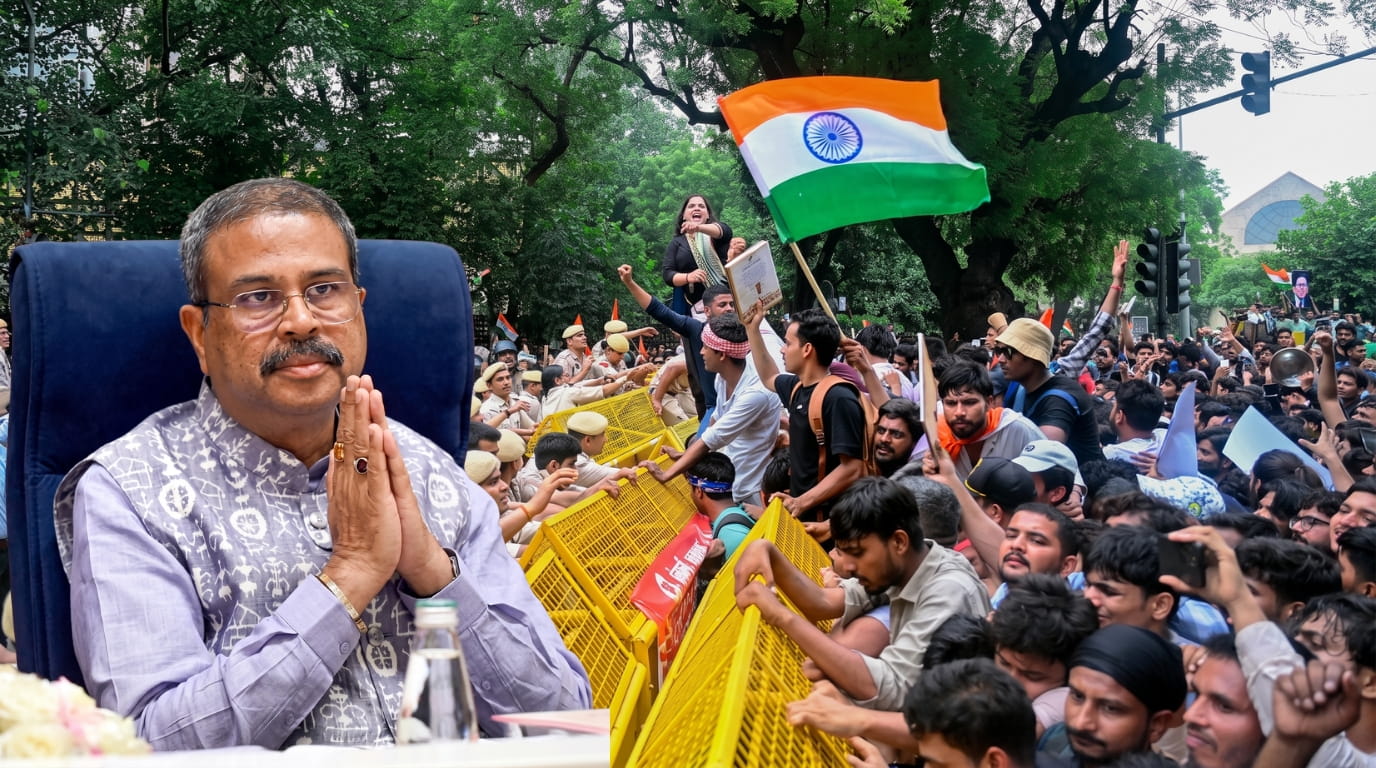
On Saturday, July 25, 2026, Dharmendra Pradhan resigned as India’s Education Minister driven out by weeks of relentless India education protests that shut metro stations, filled streets with tear gas, and put one of PM Narendra Modi’s closest allies directly in the crosshairs of an angry generation. This is one of the most significant protest wins against Modi’s government in recent memory. But the resignation is the end of one chapter, not the whole story. To understand what actually happened and why it matters you need to know about the NEET-UG exam paper leak, the rise of the Cockroach Janta Party, and the youth movement that refused to go home. This post breaks all of it down: who resigned and why, what the protest movement is, a clear timeline from the first leak to the cabinet exit, and what comes next.
Key Takeaways
- On July 25, 2026, Dharmendra Pradhan resigned as India’s Education Minister following sustained India education protests over the NEET-UG exam paper leak scandal.
- The Cockroach Janta Party (CJP), founded by 30-year-old Abhijeet Dipke, emerged as the organizational backbone of the movement, with climate activist Sonam Wangchuk amplifying its national profile through a 26-day hunger strike.
- The NEET-UG leak struck a nerve because India’s government job and education market is brutally competitive a leaked paper doesn’t just feel unfair, it can erase years of a student’s life.
- Pradhan’s resignation came just before a scheduled round of government negotiations, suggesting a preemptive move to relieve political pressure.
- The underlying grievances exam integrity, job scarcity, institutional corruption are structural challenges shared across South Asia, not unique to India.
What Triggered the India Education Protests? The NEET-UG Exam Leak Explained
The root cause is straightforward. Question papers for the NEET-UG India’s national undergraduate medical entrance examination were leaked before the test date, giving a subset of students advance access to answers. For everyone else, years of preparation were instantly rendered unfair.
That might sound like an administrative failure. It is. But it’s also something much larger.
India’s government job and higher education markets are ferociously competitive. The NEET-UG alone sees over 2.3 million applicants competing for a limited number of medical college seats each cycle. For millions of young Indians, these exams represent one of the only reliable paths to economic stability. A coaching culture has grown up around them students, many from middle-income families, invest years and significant money preparing. When a paper leaks, the damage isn’t just procedural. It’s personal. It’s years of someone’s life, made worthless overnight.
That’s why the India exam paper leak protests spread so fast. The leaked paper became a symbol of job scarcity, of institutional rot, of a government seen as unresponsive to young people. Students weren’t only demanding one minister’s head. They were expressing a deeper, structural frustration that had been building long before June 2026.
The question “why are Indian students protesting in 2026” has a simple answer and a complicated one. Simply: a leaked exam paper. Complicated: everything that paper represented about what it’s like to be young in India right now.
Who Is the Cockroach Janta Party?
The Cockroach Janta Party is a youth-led protest movement that became the organizational face of the India education protests. The name needs explaining and once you hear it, you won’t forget it.
“Janta Party” translates roughly to “People’s Party.” The “Cockroach” prefix wasn’t chosen at random. After a judge made a disparaging remark characterizing unemployed youth as “parasites and cockroaches,” the protesters flipped the insult. They reclaimed it. The message was clear: we are resilient, we survive, and we cannot be stamped out. That reframing gave the Cockroach Janta Party its identity defiant, sardonic, and impossible to dismiss.
The movement was founded by Abhijeet Dipke, a 30-year-old activist who built the CJP into the organizational engine behind the street protests. Dipke gave the movement structure at a moment when outrage alone wasn’t enough.
The protests were centered at Jantar Mantar in New Delhi India’s historic open-air space that functions as a government-designated protest site. It has hosted major demonstrations for decades, and its significance isn’t lost on anyone who shows up there. Choosing Jantar Mantar signals seriousness. It says: we are here, legally, and we are not leaving.
The Cockroach Janta Party’s profile rose significantly when Sonam Wangchuk joined the movement. Wangchuk is a climate activist and engineer from Ladakh internationally recognized, and widely known as one of the inspirations behind the Bollywood film 3 Idiots. His decision to conduct a 26-day hunger strike at Jantar Mantar elevated the protest from a student grievance into a national conversation. When someone of Wangchuk’s credibility puts his body on the line, the political cost of ignoring the movement goes up sharply.
Timeline: From the First Leak to Dharmendra Pradhan’s Resignation
| Date | Event |
| June 2026 | Protests begin at Jantar Mantar in response to the NEET-UG exam paper leak. Student groups demand accountability and ministerial action. |
| Mid-July 2026 | The Modi government promises fast-track courts to handle exam leak cases. Protesters reject the partial measure and continue demanding Pradhan’s removal. |
| Monday, July 20 | Police deploy baton charges and tear gas against student demonstrators. Dozens are injured. Videos spread rapidly across social media. |
| Days following July 20 | Authorities impose internet restrictions in affected areas. 18 Delhi metro stations are closed to limit protesters’ ability to gather. |
| Saturday, July 25 | Dharmendra Pradhan resigns via a post on X (formerly Twitter), stating that “anti-national forces” could exploit the unrest — a framing immediately and forcefully rejected by protest leaders and opposition politicians alike. |
The resignation came just before a scheduled round of talks between government officials and protest leaders. That timing matters. It suggests the government read the political pressure and moved preemptively, rather than waiting for negotiations to force the issue.
Note: This is a developing story. The situation continues to evolve as of publication.
Who Is Dharmendra Pradhan?
Dharmendra Pradhan is a senior leader of the Bharatiya Janata Party (BJP) and one of PM Narendra Modi’s closest political allies. Before serving as Education Minister, Pradhan held the Petroleum and Natural Gas portfolio a position that established him as one of the government’s most trusted technocratic managers.
The Education Ministry is not a minor posting in India. It governs policy for one of the largest student populations on earth. Exam regulations, curriculum reform, and university funding all flow through this office. For hundreds of millions of Indian families, the Education Minister’s decisions directly shape whether their children have access to economic mobility. The political weight of that portfolio is enormous which is precisely why Pradhan’s resignation carries the symbolic force that it does.
His resignation statement blamed “anti-national forces” for exploiting the student unrest. That framing landed poorly. Critics, including protest leaders and opposition parties, called it a deflection an attempt to recast a domestic governance failure as an external threat. The framing has since become a flashpoint in the political aftermath of the resignation.
What Does Pradhan’s Resignation Mean Politically?
Call it plainly: this is a rare, concrete win for opposition parties and grassroots movements against the Modi government. Sustained street pressure forced a cabinet exit. That doesn’t happen often under this administration.
The BJP framed Pradhan’s departure as a selfless act a minister stepping aside to ensure students could focus on their futures without political distraction. Opposition parties called it a democratic victory and proof that peaceful protest still carries weight. Both readings are in play simultaneously.
What’s harder to dispute is the timing. Pradhan resigned before a scheduled round of negotiations with protest representatives. That sequence resignation first, talks second signals that the government calculated the political cost of keeping him in the chair was higher than the cost of the optics of being pressured out. It’s a pragmatic move dressed in the language of sacrifice.
For Modi’s broader political standing, the episode adds a complicating data point. The government has faced youth unemployment criticism for years. A cabinet minister forced out by student protesters makes that criticism harder to wave away heading into future electoral cycles.
What Happens Next for India’s Education Protests?
Several questions remain genuinely open.
The fast-track courts promised by the government in mid-July have not yet delivered results. Whether that process accelerates or quietly stalls will tell you a great deal about how seriously the government is taking the underlying demands, as opposed to just the political optics of the resignation.
Protest leaders have not declared full victory. The Cockroach Janta Party’s demands extended beyond Pradhan’s removal to include systemic reform of the exam administration process and accountability for those who facilitated the leak. Whether those demands are now negotiated or abandoned will shape the movement’s next phase.
The key appointment to watch: who replaces Dharmendra Pradhan as Education Minister? The name chosen will signal whether the Modi government intends genuine reform or a straight continuation of existing policy under a new face. A reformist appointment would suggest the protests moved the needle. A loyalist placeholder would suggest the resignation was damage control, not course correction.
Why This Resonates Beyond India
The India education protests aren’t an isolated event. They fit into a recognizable regional pattern youth-led movements demanding government accountability over exam integrity, job scarcity, and institutional corruption.
Pakistan’s own students have navigated similar frustrations: competitive entrance exams, limited government posts, and a persistent sense that the system rewards connection over merit. Nepal has seen comparable street pressure over public sector job access. Across South Asia, the structural conditions that produced the NEET-UG protests a large young population, insufficient formal employment, and high-stakes examinations as the primary gateway to stability are not unique to any one country.
The Cockroach Janta Party’s specific context is Indian. But the underlying anger? That travels.
What makes the Indian case significant for the broader region is the outcome. A sitting minister in a politically dominant government was removed by sustained street pressure from young people. That’s a proof of concept. South Asian youth movements don’t always win visible victories. This one did at least at this stage.
A Milestone Not a Final Victory
Dharmendra Pradhan’s resignation is a real political milestone. A sitting minister in one of the world’s most electorally dominant governments was removed by sustained pressure from young people on the street. That’s not a small thing.
But it’s not a final victory either.
The NEET-UG leak remains unresolved. The fast-track courts haven’t delivered. The Cockroach Janta Party’s broader reform demands structural changes to exam administration, genuine accountability for those who facilitated the leak are still on the table. One resignation addresses the political symbolism. It doesn’t fix the underlying system.
Watch the next appointment. Watch the courts. Watch whether the CJP stays organized or disperses once the immediate pressure lifts.
What the protests have already proven is harder to undo: when South Asian youth mobilize with consistency and clarity, governments move. That’s the signal this moment sends and it will be heard well beyond New Delhi.
Frequently Asked Questions
Who is Dharmendra Pradhan?
Dharmendra Pradhan is a senior BJP leader and longtime ally of PM Narendra Modi. He previously served as India’s Petroleum and Natural Gas Minister before taking on the Education portfolio. Pradhan resigned on July 25, 2026, following weeks of sustained student protests over the NEET-UG exam paper leak. His resignation came just before scheduled government talks with protest leaders.
What is the Cockroach Janta Party?
The Cockroach Janta Party (CJP) is a youth-led protest movement founded by 30-year-old Abhijeet Dipke. The name reclaims an insult after a judge described unemployed youth as “parasites and cockroaches,” protesters adopted the term as a symbol of resilience. The CJP became the organizational backbone of the India education protests, staging demonstrations at Jantar Mantar in New Delhi and coordinating street mobilizations that ultimately led to Pradhan’s resignation.
Why are Indian students protesting over exam papers in 2026?
Question papers for the NEET-UG India’s national medical entrance exam were leaked before the test date, giving some students an unfair advantage. With over 2.3 million applicants competing for limited medical college seats each cycle, the integrity of the exam is not an abstract concern. For millions of students who invest years and significant money preparing, a leaked paper can erase that entire investment. The leak became a flashpoint for deeper frustrations: job scarcity, institutional corruption, and a government perceived as unaccountable to youth.
What reforms has the Indian government promised?
The Modi government announced fast-track courts to handle exam leak cases as part of its response to the India education protests. Protesters initially rejected this as an insufficient partial measure and continued demanding Pradhan’s removal. As of publication, those courts have not yet delivered substantive outcomes. Whether the commitment translates into enforceable accountability or remains a political promise without follow-through is among the key developments to monitor.
Who might replace Dharmendra Pradhan as Education Minister?
As of publication, no successor has been officially named. The appointment of a new Education Minister is one of the most politically significant decisions the Modi government will make in the immediate aftermath of the India education protests. A reformist choice would suggest the protests forced genuine recalibration. A loyalist appointment would suggest the resignation was primarily about managing optics. On Record Pakistan will report on this development as it unfolds.