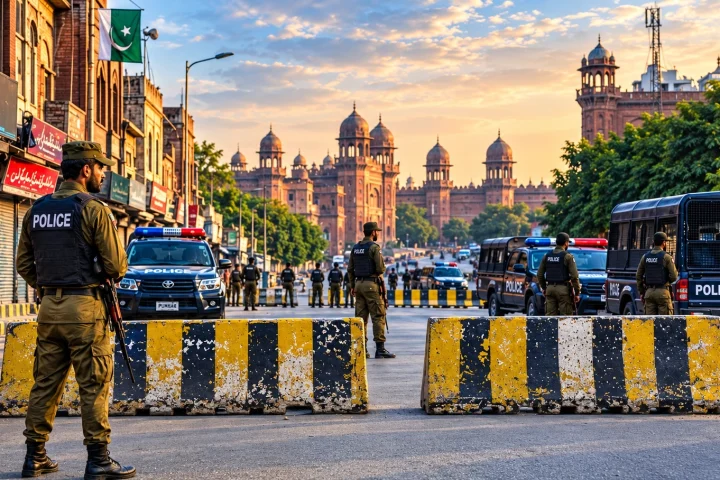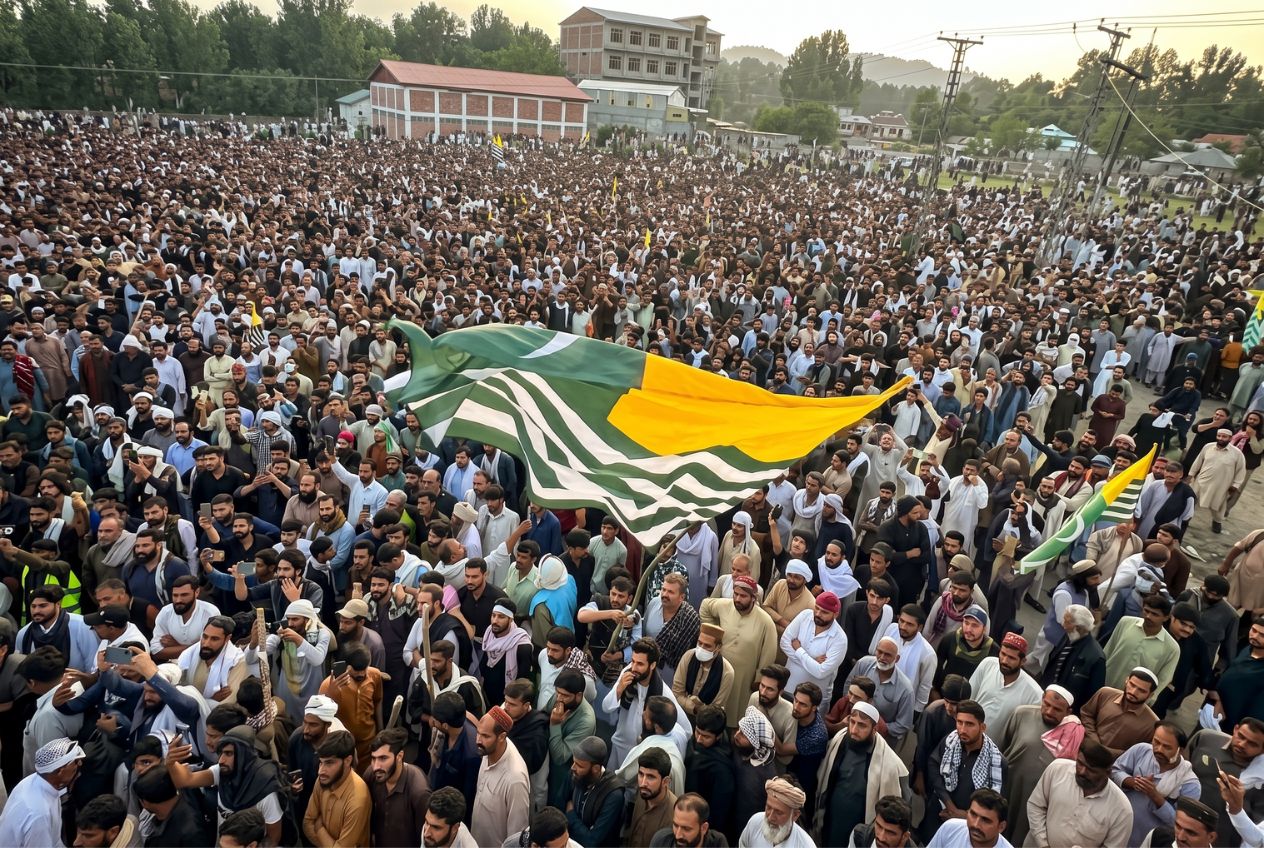
Pakistan-administered Kashmir (AJK) is holding a staggered three-phase election amid ongoing protests, an internet blackout, and a disputed death toll. The crisis stems from JAAC’s demand to abolish 12 reserved Assembly seats allocated to Kashmiri refugees living in mainland Pakistan. Two phases are complete; Phase 3 voting is underway today, August 10, 2026, but with a major twist: only 4 constituencies are voting, while 7 have been indefinitely postponed.
If you’ve been scrolling through headlines protests, a staggered three-phase election, internet blackouts, and a death toll that nobody seems to agree on you’re not alone in feeling lost. This is one of the most complex political crises unfolding in Pakistan-administered Kashmir right now, and most coverage assumes you already know the backstory.
You probably don’t. That’s fine. This piece starts from the beginning.
Here’s what we’ll cover: what AJK actually is and why its legal status is so unusual, who JAAC is and where they came from, what the 12 disputed refugee seats are and why they triggered a crisis, how the three-phase election is structured, what the human toll looks like (and why the numbers are contested), and what comes next.Phase 3 voting in Poonch division is taking place today—for live seat tallies, key candidate races, and coverage of the 7 postponed constituencies, see our complete guide: AJK Elections Phase 3: Full Results, Key Races & What Comes Next.
What Is Pakistan-Administered Kashmir? A Quick Primer
Pakistan-administered Kashmir is the portion of the disputed Kashmir region currently governed by Pakistan but it is not formally part of Pakistan as a province. That distinction matters enormously, and it shapes everything else in this story.
To understand why, you need to go back to 1947. When British India was partitioned into India and Pakistan, the princely state of Jammu and Kashmir became an immediate flashpoint. A war broke out. When a ceasefire was brokered in 1948, the fighting had drawn a de facto boundary later formalized as the Line of Control (LoC) in 1972 that divided the region between the two countries. Pakistan administers the western portion; India administers the larger eastern portion.
Pakistan’s administered territory is itself divided into two distinct entities with different legal statuses: Azad Jammu and Kashmir (AJK) and Gilgit-Baltistan. They are not the same thing. Gilgit-Baltistan has been given a provisional provincial status. AJK has something more unusual.
AJK has its own elected Legislative Assembly, its own prime minister, and its own high court. It functions, in practical terms, like a self-governing territory. But here’s the catch: AJK is not a full Pakistani province, and Pakistan’s official position is that it cannot be, because the final status of Kashmir is yet to be determined through a UN-mandated plebiscite. Making AJK a formal province would, in Pakistan’s legal reasoning, prejudice the outcome of that plebiscite. So AJK’s constitutional status is deliberately left unresolved suspended between self-governance and full integration, by design.
Think of it this way: AJK has all the machinery of a regional government, but its legal foundation is built on a territorial question that has never been answered.
New to this story? Key terms defined:
- Line of Control (LoC): The de facto border between Pakistani- and Indian-administered Kashmir, established after the 1947 war and formalized in 1972. Not an internationally recognized permanent border.
- AJK (Azad Jammu and Kashmir): The self-governing territory administered by Pakistan that is the focus of this article. Not a formal Pakistani province.
- AJK Legislative Assembly: AJK’s elected parliament, which chooses the AJK prime minister and passes regional legislation.
- 12 Refugee Seats: Reserved seats in the AJK Legislative Assembly allocated to Kashmiri refugees who fled to Pakistan after 1947 and now live in mainland Pakistani cities. The central flashpoint of the current crisis.
What Sparked the Kashmir Elections Crisis? The 12 Disputed Seats
At the center of the AJK election crisis are 12 reserved seats in the AJK Legislative Assembly seats allocated not to residents of AJK, but to Kashmiri refugees who left for Pakistan after 1947 and now live in cities like Lahore, Karachi, and Rawalpindi.
Here’s why that matters. Voters for these 12 AJK elections disputed seats are registered outside AJK. That means the political parties best positioned to win them are not grassroots AJK parties, but national Pakistani parties PML-N and PPP specifically with large, established organizational machinery in those mainland cities. Win enough of those 12 seats, and a national party can significantly influence the composition of the AJK Assembly, and by extension, the AJK government and how it directs development funds.
JAAC’s argument stated plainly: these seats hand the keys to AJK’s government to parties whose real base of power is hundreds of kilometers away in Islamabad, Lahore, or Karachi. The result, JAAC contends, is that AJK’s development priorities get shaped by external political calculations rather than local needs.
The government’s counterposition is equally clear. On June 7, 2026, the AJK Supreme Court ruled that the 12 seats are constitutionally protected and cannot be abolished without a formal constitutional amendment. The court’s ruling settled the legal question, at least for now.
But JAAC’s demand was never purely legal. The committee argues that a seat being constitutionally valid and a seat being politically legitimate are two different things. Legal protection does not, in their view, resolve the underlying problem of external influence. That gap — between constitutional validity and political legitimacy — is where the crisis lives.
Who Is JAAC?
JAAC stands for Jammu and Kashmir Joint Awami Action Committee. It was formed in 2023, and its origins had nothing to do with elections.
The committee grew out of public anger over electricity bills and wheat shortages. These were economic grievances felt by ordinary households the kind that translate quickly into street protests when people feel ignored. JAAC gave that anger to an organized outlet. By 2024, protests had escalated, the government made partial concessions, and JAAC’s credibility as a pressure group grew considerably.
Then, in late 2025, JAAC expanded its scope. The committee presented a 38-point charter that extended its demands from economic relief into political reform. The centerpiece and the one demand JAAC has called non-negotiable is the abolition of the 12 refugee seats.
On June 5, 2026, the government formally banned JAAC and placed bounties on the committee’s spokespeople, citing security concerns. Those actions are documented in official government communications and are a matter of public records. Whether banning JAAC was a proportionate or effective response is a separate question, what is clear is that it did not end the protests.
To present both sides plainly: JAAC frames its demands as a fight for AJK’s political autonomy and equitable governance. The government frames JAAC, at least since the ban, as an unlawful organization posing a security risk. Those two characterizations have not yet been reconciled.
Timeline of the Kashmir Elections Crisis
| Date | Event |
| Late May 2026 | Talks between JAAC and the AJK government collapse |
| June 5, 2026 | JAAC formally banned by government; internet suspended in parts of AJK |
| June 7, 2026 | AJK Supreme Court rules 12 refugee seats are constitutionally protected |
| June 8–9, 2026 | Deadly clashes reported across AJK; general strike called |
| July 21, 2026 | Three-phase staggered election announced |
| July 27, 2026 | Phase 1: Mirpur division votes — completed (early PML-N lead reported) |
| August 2, 2026 | Phase 2: Muzaffarabad division votes — completed amid boycott calls |
| August 10, 2026 | Phase 3: Poonch division — Voting underway (Read our Phase 3 Coverage) |
The decision to stagger the Pakistan-administered Kashmir elections across three phases was a direct response to the security situation. Protest activity was not uniform across AJK’s three divisions different areas had different levels of unrest at different times. A staggered schedule allowed authorities to manage security resources division by division, rather than deploying across the entire territory simultaneously. Whether that reasoning also reflected political calculations is a question analysts continue to debate.
The Three Voting Phases — At a Glance
| Phase | Date | Division | Status / Early Result | Notable Context |
| Phase 1 | July 27, 2026 | Mirpur | Completed — early PML-N lead reported | Relatively lower protest activity in Mirpur division |
| Phase 2 | August 2, 2026 | Muzaffarabad | Completed — held amid active boycott calls | AJK’s capital city; higher protest concentration |
| Phase 3 | August 10, 2026 | Poonch | Voting underway (4 seats active, 7 postponed) | Final phase; AJK Elections Phase 3 Results |
Note: : Phase 3 voting is underway today in Bagh and Haveli, while 7 seats in Poonch and Sudhnoti have been postponed due to security concerns. For live candidate profiles and seat tallies, track our AJK Elections Phase 3 Tracker
The Human Toll and the Information War
The casualty figures from the June protests are genuinely contested. No single number should be treated as settled fact. Here is what each source has stated, attributed directly.
Amnesty International documented approximately 40 deaths, roughly 34 protesters and 6 security personnel based on their own public reporting. This is the most widely cited verified figure from an independent international organization.
Local sources and protest groups, including various resident accounts and statements from organizations affiliated with JAAC, have cited figures ranging from more than 50 to over 60 deaths. These figures have not been independently verified by an international body.
The official Pakistani government has not publicly confirmed any death toll as of the time of publication. That absence is itself a documented fact worth naming.
The Kashmir protests death toll dispute is inseparable from the information environment. The internet blackout, imposed around June 5 when the government banned JAAC, affected large parts of AJK. Restricted connectivity made it harder for journalists, residents, and researchers to document events in real time or verify claims as they emerged.
Into that information gap flowed a significant amount of video and photographic content on social media. iVerify Pakistan, a Pakistani fact-checking organization, documented a pattern during the blackout period: a mix of authentic footage from the protests alongside material that had been flagged as AI-generated or recycled from unrelated events. This article does not assert that any specific piece of viral content is true or false. What is documented is the pattern authentic material and misleading material circulating together, in an environment where normal verification was significantly harder.
The Political Stakes: PML-N, PPP, and What the Election Means
Understanding the political dynamics here requires holding two overlapping tensions at once.
First: the AJK prime minister, Faisal Mumtaz Rathore, is affiliated with PPP. The federal government in Islamabad, however, is led by a PML-N-led coalition. AJK’s elected government and Pakistan’s federal government are from rival parties. That tension has shaped how both sides have communicated about the crisis and what each has to gain or lose from the election results.
PPP leadership, including statements attributed to Bilawal Bhutto Zardari has publicly claimed that 35 of JAAC’s 38 demands have already been met. That claim positions PPP as responsive to public pressure while framing the remaining 3 demands (including the refugee seat abolition) as the sticking point. JAAC has disputed characterization.
PML-N, meanwhile, reported an early lead in Phase 1 results from the Mirpur division. If that momentum carries through Poonch division’s Phase 3 results, PML-N could emerge with enough Assembly seats to form the next AJK government which would give the federal ruling coalition direct control over AJK’s executive, removing the current PPP-PML-N tension at the AJK level.
On the question of foreign involvement: Pakistan’s Inter-Services Public Relations (ISPR) publicly rejected allegations that Indian interference was driving the protests. India, for its part, rejected Pakistan’s framing. Both rejections are on public records. This article presents them as stated positions, not as verified facts about the protests’ origins.
What Happens Next: The August 10 Poonch Division Vote and Beyond
The most important near-term event is straightforward: Phase 3 voting in Poonch division on August 10, 2026. Until those results are counted, the full composition of the AJK Legislative Assembly remains unknown, and any analysis of who controls AJK’s next government is premature.
After August 10, several questions will determine whether the crisis winds down or continues.
- Will protest activity ease once all three phases are complete? Elections can act as a pressure-release valve or they can sharpen grievances if the outcome is seen as illegitimate.
- Will JAAC accept the election results? The committee called for boycotts during Phase 2 in Muzaffarabad. Its stance toward a fully elected Assembly will signal whether the political conflict enters a new phase or stabilizes.
- How will the new AJK Assembly address the 12 refugee seats? The AJK Supreme Court ruled the seats constitutionally protected. That doesn’t prevent the Assembly from pursuing a constitutional amendment — but it requires political will that has not yet materialized.
- What will the international response look like? Human rights organizations that documented the protests will be watching the post-election environment closely.
The Poonch division election on August 10 is a milestone. It is not an endpoint.
What This Crisis Tells Us and What Comes Next
If you came here not knowing what AJK was, you now have the context that most headlines take for granted. Three things make this crisis significant, and none of them will disappear when the votes are counted.
First, the disputed seats: 12 Assembly positions sit at the intersection of refugee rights, democratic representation, and the question of who really governs AJK. A court has ruled them constitutional. JAAC says that misses the point. That argument is unresolved.
Second, the human cost: the protests that preceded this election left dozens dead, by even the most conservative documented count. Those deaths occurred in an environment of restricted information which means the full picture may take years to emerge.
Third, the governance question: AJK’s unusual constitutional status is not a technicality. It shapes every political decision made in the territory, from how elections are structured to why 12 refugee seats can cause this level of crisis. The election is a moment in a much longer story.
Phase 3 voting from Poonch division is taking place today. Return to On Record Pakistan and read AJK Elections Phase 3 Coverage for verified post-election results, Assembly composition data, and ongoing analysis as the new government takes shape.
Frequently Asked Questions
What are the 12 disputed seats in the AJK Legislative Assembly?
The 12 disputed seats are reserved seats in AJK’s Legislative Assembly allocated to Kashmiri refugees who fled to Pakistan after 1947. These voters are registered not in AJK itself, but in mainland Pakistani cities like Lahore, Karachi, and Rawalpindi. JAAC wants these seats abolished because, in the committee’s view, they allow national Pakistani political parties with large organizational networks in those cities to disproportionately influence AJK’s Assembly composition and government priorities.
Who is JAAC and what do they want?
JAAC is the Jammu and Kashmir Joint Awami Action Committee, a grassroots coalition formed in 2023. It began as a response to economic hardships rising electricity bills and wheat shortages before expanding its demands in late 2025 to a 38-point governance charter. JAAC’s central, non-negotiable demand is the abolition of the 12 refugee seats. The government banned JAAC on June 5, 2026 and placed bounties on its spokespeople, citing security concerns.
How many people have died in the Kashmir protests?
Casualty figures are contested and should not be treated as settled. Amnesty International documented approximately 40 deaths (around 34 protesters and 6 security personnel) based on its own public reporting. Local sources and protest groups have cited figures ranging from over 50 to more than 60 deaths. As of publication, the official Pakistani government has not publicly confirmed any death toll.
Why is there an internet blackout in Pakistan-administered Kashmir?
The internet blackout was imposed in parts of AJK around June 5, 2026, at the same time the government formally banned JAAC. The blackout significantly restricted the flow of information out of the region making it harder for journalists, researchers, and independent observers to document events in real time. iVerify Pakistan documented a pattern during this period where authentic footage of the protests circulated alongside AI-generated or recycled material from unrelated events.
How is Azad Jammu and Kashmir different from the rest of Pakistan?
AJK has its own elected Legislative Assembly, its own prime minister, and its own high court — but it is not a formal Pakistani province. Pakistan’s official position is that AJK’s final status must be resolved through a UN-mandated plebiscite, and formally incorporating AJK as a province would prejudice that outcome. AJK’s governance structure is therefore deliberately left in a form of constitutional suspension: self-governing in practice, unresolved in status.
What does the Line of Control mean?
The Line of Control is the de facto border between Pakistani-administered and Indian-administered Kashmir. It was established after the first India-Pakistan war over Kashmir in 1947–1948 and formally demarcated under the Simla Agreement in 1972. The LoC is not an internationally recognized permanent border both India and Pakistan claim the entire Kashmir region but it has functioned as the effective boundary between the two sides for decades.