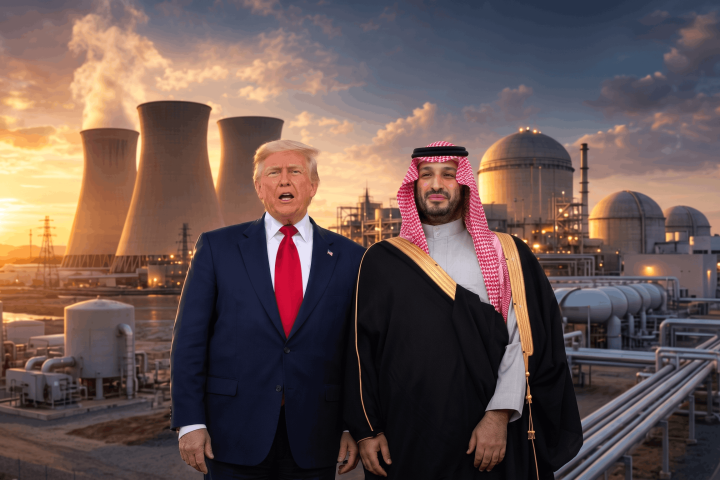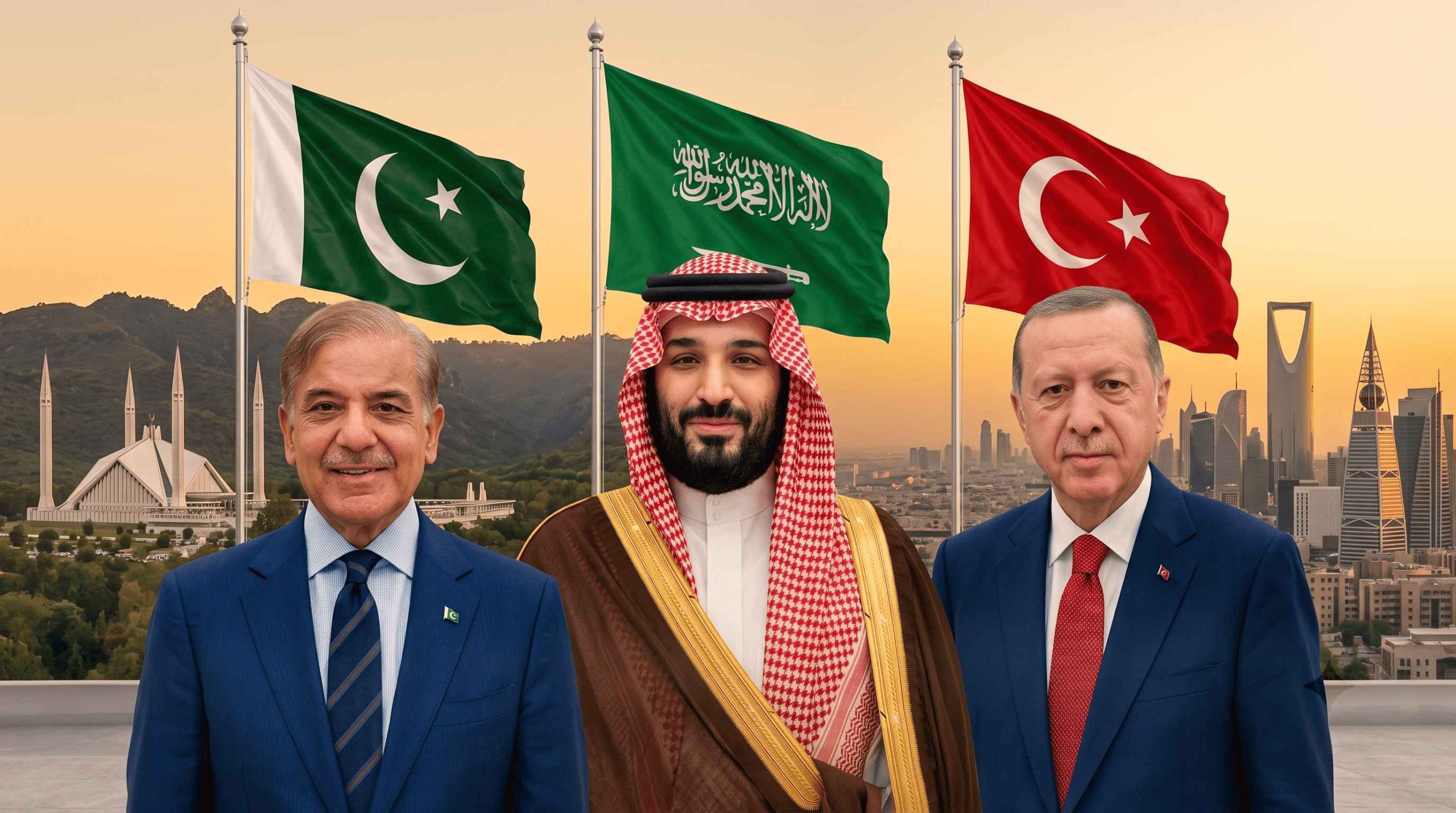
On August 7, 2026, Pakistan, Saudi Arabia, and Türkiye signed a trilateral joint defence agreement in Mecca/Jeddah, expanding the original September 2025 Pakistan-Saudi bilateral SMDA. The pact creates a collective security clause modeled on NATO’s Article 5. Türkiye’s inclusion marks a significant geopolitical shift though the reasons behind Ankara’s reversal from its January 2026 “no” remain unconfirmed by sourced reporting.
On August 7, 2026, Pakistan, Saudi Arabia, and Türkiye signed a landmark trilateral joint defence agreement in Mecca/Jeddah. That single sentence tells you what happened. What it doesn’t tell you is why and that’s the part that matters.
Most coverage has stopped at the wire-update level: brief, confirmed, and thin on context. If you’ve searched for what was actually signed, why Türkiye reversed course after reportedly declining in January, or what this means for India, Iran, and the broader region, you’ve likely come up empty.
This article fills that gap. It explains the Pakistan Saudi Arabia defence pact in full what the agreement commits each country to, the history behind the Strategic Mutual Defence Agreement (SMDA) that started it all, the three overlapping crises that made a trilateral arrangement feel urgent, the still-unresolved nuclear question, and how neighboring states are reacting.
Here’s what you need to know.
What Was Actually Signed?
At its core, the August 7 agreement is a trilateral collective security clause. The principle is straightforward: an act of armed aggression against any one of the three signatories Pakistan, Saudi Arabia, or Türkiye is treated as an act of aggression against all three. Think of it as a regional version of NATO’s Article 5, applied to a specific set of Muslim-majority states.
In practical terms, each country is committing to provide mutual military assistance if a partner state is subjected to external armed attack. The scope is state-level. The agreement explicitly does not cover internal unrest, civil conflicts, or threats from non-state actors a meaningful carve-out that limits its application to conventional inter-state aggression.
A few things worth being clear about: the full text of the trilateral agreement has not been publicly released as of the signing date. Some provisions remain unconfirmed. Responsible analysis requires naming that gap rather than filling it with speculation.
What is confirmed is that this trilateral pact is an expansion of the original bilateral Strategic Mutual Defence Agreement signed between Pakistan and Saudi Arabia in September 2025. Türkiye’s entry as a full partner is the defining new element — and it changes the geographic footprint, the strategic weight, and the political signal of the arrangement significantly.
Background: The Pakistan-Saudi Bilateral Pact That Started It All
To understand the August 7 agreement, you need to go back to September 17, 2025. That’s when Prime Minister Shehbaz Sharif and Crown Prince Mohammed bin Salman signed the original Strategic Mutual Defence Agreement in Riyadh a bilateral deal between Pakistan and Saudi Arabia that established the framework the trilateral pact now builds on.
The timing wasn’t accidental. The SMDA’s urgency was driven, at least in part, by the September 2025 Israeli strikes on Doha, which shook Gulf states’ confidence in the reliability of US security guarantees. Saudi Arabia had long operated under an informal American security umbrella. Those strikes made clear that the umbrella had limits. The push for an independent, formal defence framework accelerated rapidly.
Pakistan and Saudi Arabia have maintained deep military ties since the 1960s, including the training of thousands of Saudi military personnel by Pakistani forces over several decades. The SMDA wasn’t a relationship built from scratch — it was the formalization of a partnership that had existed informally for a long time.
The agreement included a reported 80,000-troop provision (widely cited in coverage of the original SMDA), outlining the scale of potential Pakistani military support to Saudi Arabia. That provision moved from paper to practice in 2026. During the Iran conflict, Pakistan reportedly activated elements of the SMDA, deploying troops, aircraft, and drone squadrons to Saudi Arabia the first real-world test of the agreement’s collective defence provisions. All troop figures and deployment details should be treated as sourced to reporting by Reuters and Bloomberg, not independently confirmed by On Record Pakistan at time of publication.
Türkiye’s Reversal: From “Not Joining” to Signing in Eight Months
This is the most important unanswered question in the story and the one that most coverage has glossed over. Walk through the timeline carefully.
January 2026: Reports emerge that Türkiye is seeking to join the Pakistan-Saudi pact, elevating it from a bilateral to a trilateral arrangement.
Later in January 2026: Sources indicate that Türkiye will not, in fact, be joining. The agreement will remain bilateral between Pakistan and Saudi Arabia.
August 7, 2026: Türkiye signs a full trilateral partner.
Eight months. A firm “no” to a full signature. No sourced reporting has yet confirmed what specifically changed between the January decision and the August 7 ceremony. That gap deserves to be named directly it’s the central unresolved question in this story.
What context can help readers understand the reversal, even in the absence of a confirmed explanation? Three factors stand out. First, the regional security environment between January and August 2026 deteriorated sharply the Iran conflict, the Houthi escalation, and continued instability from the Gaza war created a materially different threat landscape than existed when Türkiye reportedly declined. Second, Türkiye already has established defence ties with both Pakistan and Saudi Arabia, so the political cost of joining was lower than it might appear from the outside. Third, Ankara’s foreign policy has been realigning the 2026 Iran conflict appears to have accelerated a broader Turkish pivot toward new regional security arrangements.
These are contextual factors, not confirmed causes. The full explanation may emerge as more reporting surfaces. For now, treat this as a developing story within the larger story.
The Three Regional Drivers: Why This Pact, Why Now
No wire update has explained what made a broader trilateral defence arrangement feel necessary and urgent for all three signatories at this particular moment. Three overlapping crises converged to create the conditions.
How did the 2026 Iran conflict reshape Gulf security calculations?
The US-Iran conflict that erupted in 2026 was the single largest security event in the region since the Gaza war began. Its effects were immediate and direct. For Saudi Arabia, it validated the logic behind the SMDA having Pakistan’s military commitment on paper turned out to matter when Iranian tensions created a credible threat environment. Pakistan reportedly deployed troops, aircraft, and drone squadrons to Saudi Arabia under the bilateral agreement during this period (attributed to Bloomberg reporting), making the SMDA operational rather than theoretical. For Türkiye, watching the Gulf’s security architecture tested in real time likely shifted the calculus on joining.
What impact did Houthi attacks on Saudi Arabia have on the trilateral pact?
July 2026 brought a Houthi-declared “blockade” of Red Sea shipping lanes, accompanied by reported strikes near Yanbu and Najran two strategically significant Saudi locations. Yanbu houses major oil export infrastructure. Najran sits near the Yemeni border. The strikes exposed Saudi Arabia’s vulnerability to sustained Houthi targeting and made clear that bilateral and multilateral defence commitments were not an abstract luxury. They were an operational necessity.
For Saudi Arabia, the July 2026 Houthi escalation almost certainly accelerated the push to formalize the trilateral framework before the security environment deteriorated further.
How did the Gaza war’s regional spillover create momentum for new security architecture?
The broader instability generated by the Gaza conflict continued to ripple outward through late 2025 and into 2026. The September 2025 Israeli strikes on Doha were a sharp signal that no Gulf state was categorically immune from direct military action. That event created the permissive political environment in which Pakistan, Saudi Arabia, and eventually Türkiye found common cause in building a new security architecture one independent of the US umbrella that had previously provided the region’s baseline stability.
The Nuclear Question
This is the question most readers following Western coverage of the original 2025 pact will have arrived with. Address it directly: does the Pakistan-Saudi-Türkiye defence pact include a nuclear dimension?
Pakistan is the only nuclear-armed state among the three signatories. That fact drove significant speculation when the bilateral SMDA was first signed, particularly around whether Saudi Arabia had negotiated some form of nuclear security guarantee a so-called “nuclear umbrella” as part of the arrangement.
The honest answer is that no one outside the negotiations knows for certain. Here’s what has been stated publicly:
A senior Saudi official described the original agreement as “a comprehensive defensive agreement encompassing all military means.” That phrasing is deliberately ambiguous. It neither confirms nor rules out a nuclear dimension. Pakistan’s defence minister made early remarks that appeared to hint at a nuclear component, before those comments were walked back.
The Belfer Center at Harvard Kennedy School, one of the leading academic bodies tracking nuclear security arrangements, has characterized formal nuclear sharing under the SMDA as speculative and unconfirmed. Their assessment represents expert consensus as of mid-2026: the nuclear umbrella question remains open, not settled.
Do not interpret the Saudi official’s “all military means” language as confirmation. Do not interpret the walked-back Pakistani remarks as denial. The officials involved have been deliberately ambiguous, and responsible reporting reflects that ambiguity rather than resolving it artificially.
How Other Countries Have Reacted
What is India’s reaction to the Pakistan-Saudi-Türkiye defence pact?
India’s posture has been one of close and active monitoring. Indian political voices have expressed concern about the security implications of a formal Pakistan-Saudi-Türkiye trilateral defence arrangement particularly given Pakistan’s central role. A pact that binds Pakistan to two additional state partners, including a NATO member in Türkiye, changes India’s strategic calculus at its western periphery. Official Indian government statements have been measured, but the political conversation within India has been notably more candid about the perceived threat.
How has Iran responded to the trilateral pact?
Iran’s reaction contains a counterintuitive element. When the original bilateral SMDA was signed in September 2025, Iran notably welcomed the agreement, framing it as a step toward a “comprehensive regional security system.” That response surprised many analysts expecting Iranian hostility toward a Pakistan-Saudi security arrangement. Whether Türkiye’s addition to the pact changes Iran’s calculus is a developing story point Ankara brings a different geopolitical footprint to the arrangement, and Tehran’s initial welcome may not extend to the trilateral version.
What is the broader international reaction?
The US, Israel, and the Gulf Cooperation Council states are each watching the emergence of this independent regional security axis closely. Official statements from these actors have been limited at the time of writing. The more consequential reactions will likely come as the full text of the agreement becomes available, and the pact’s operational dimensions become clearer.
What Happens Next
Several milestones will shape how this story develops.
The most important near-term development is whether the complete text of the trilateral agreement is made public. The original SMDA’s nuclear provisions or lack thereof remain unconfirmed partly because the full document hasn’t been released. The same question will hang over the August 7 agreement until it is.
Official Indian and Iranian responses to Türkiye’s inclusion. Türkiye joining the pact changes its geographic scope and its geopolitical weight in ways that a bilateral Pakistan-Saudi arrangement did not. Both India and Iran are likely to recalibrate their formal positions once the initial coverage settles and the diplomatic implications become clearer.
Potential expansion. Whether other regional states express interest in associating with or formally joining the framework will determine whether the SMDA evolves into a broader collective security organization or remains a tight trilateral arrangement. That question won’t be answered quickly, but it’s the right one to track over the next twelve months.
The Story Is Still Being Written
The August 7, 2026, signing is not just a news event. It’s the most recent step in a structural realignment of Middle East and South Asian security architecture that began with the September 17, 2025, SMDA and that realignment is still in motion.
Two questions sit at the center of what’s unresolved. First: Why did Türkiye reverse its January 2026 position and sign as a full trilateral partner? The contextual factors are visible; the confirmed explanation is not yet public. Second: does the trilateral pact carry any formal nuclear dimension? The official language has been crafted to avoid answering that question directly, and the expert consensus is that it remains genuinely open.
Both questions will likely find their answers as the full text of the agreement becomes available and diplomatic reactions from India and Iran develop further. That reporting will take time. This piece will be updated as new information emerges.
For verified source documents, government statements, and ongoing policy analysis related to the Pakistan-Saudi-Türkiye defence pact, visit On Record Pakistan. This is where the primary record lives and where we’ll continue tracking this story as it develops.
Frequently Asked Questions
What is the Strategic Mutual Defence Agreement (SMDA)?
The Strategic Mutual Defence Agreement is the bilateral defence pact signed on September 17, 2025, in Riyadh by Prime Minister Shehbaz Sharif and Crown Prince Mohammed bin Salman. The agreement established a formal military partnership between Pakistan and Saudi Arabia, including a reported 80,000-troop provision committing Pakistani forces to Saudi Arabia’s defence in the event of an armed attack. The August 7, 2026 trilateral agreement expands the SMDA framework to include Türkiye as a full partner.
Does the Pakistan-Saudi defence pact include nuclear weapons sharing?
This remains unverified. Pakistan is the only nuclear-armed state among the three signatories. A Saudi official described the original agreement as covering “all military means” language that is deliberately ambiguous. Pakistan’s defence minister made early remarks suggesting a nuclear component, before walking them back. The Belfer Center and other expert bodies characterize formal nuclear sharing under the SMDA as speculative and unconfirmed. The full agreement text has not been released, so no definitive assessment is possible at this stage.
Why did Türkiye join the Saudi-Pakistan defence pact?
No sourced reporting has confirmed what specifically changed between January 2026, when Türkiye was reported to have declined membership, and August 7, 2026, when Türkiye signed as a full trilateral partner. Contextual factors the 2026 Iran conflict, Houthi escalation, and Ankara’s broader foreign policy realignment provide plausible background, but the actual reason for the reversal has not been publicly confirmed.
How many troops has Pakistan sent to Saudi Arabia?
The original bilateral SMDA included a reported 80,000-troop provision (widely cited in Reuters coverage of the agreement). During the 2026 Iran conflict, Pakistan reportedly deployed troops, aircraft, and drone squadrons to Saudi Arabia under this provision the first operational activation of the SMDA’s collective defence clause. Precise deployment figures have not been confirmed by Pakistani or Saudi government statements as of August 7, 2026.
What is India’s reaction to the Pakistan-Saudi-Türkiye defence pact?
India has adopted a posture of close monitoring. Indian political voices have expressed concern about the security implications of a formal trilateral arrangement binding Pakistan, Saudi Arabia, and Türkiye. The concern centers on what a formalized, multi-state defence commitment for Pakistan means for India’s strategic environment at its western periphery. Official statements have been cautious; the political reaction within India has been more direct about the perceived implications.